
Miscanthus in 2057: Journey into the climate of the future
Miscanthus in 2057: Journey into the climate of the future
Mid-October saw the annual meeting of " MisTigation " (AAP GRAINE 2022).
We met up with the project's partner teams in Gembloux (Belgium) for a day of exchanges on work in progress and results already obtained.
The program included ecosystem services, nitrogen management by the plant, performance projections in future climates, and new perspectives for miscanthus breeding. We were also able to visit one of the project's flagship facilities, the Ecotron at the TERRA research center.
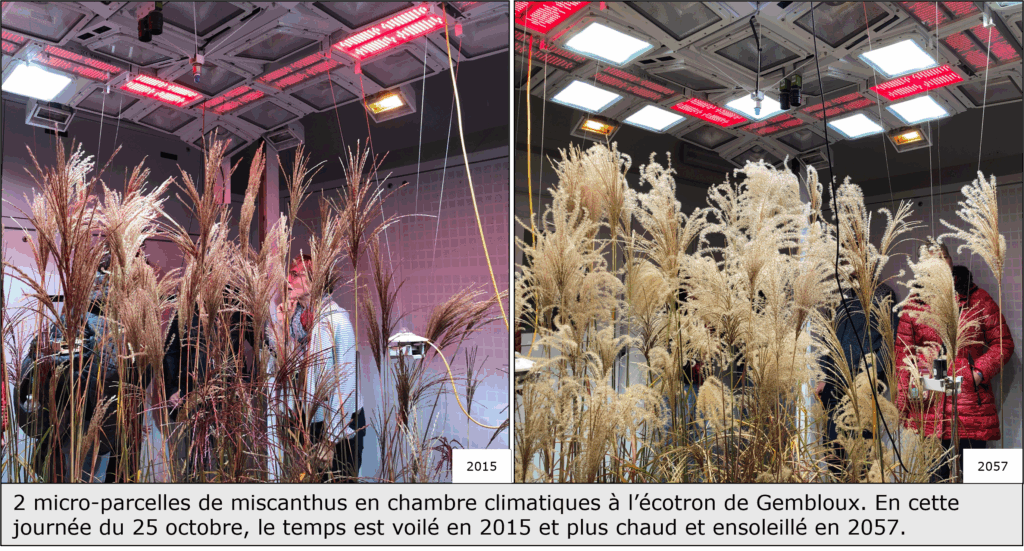
The ecotron reproduces a micro-parcel of miscanthus in a closed chamber, enabling soil-plant-atmosphere exchanges to be measured and monitored. For MisTigation, nitrogen fluxes are monitored over a 10-month period, using 2 different weather years for Estrées-Mons (80): 2015, representative of the current climate, and 2057, representative of the future climate with an extreme event (based on the RACMO-EC-Earth climate model, RCP 8.5).
Focus on the first results:
- From Novabiom, Emilie Skowron presented a bibliographical review of miscanthus ecosystem services, a map of preferred miscanthus planting areas, and a guide for local authorities on how to set up projects combining heating AND environmental services (water quality protection, erosion, etc.).
- Hélène Desmyttère (JUNIA) presented simulations of miscanthus cultivation in future climates using the "STICS" cultivation model. The general trend is towards faster growth for similar yields, and the effect of water stress has yet to be assessed. These simulations complement the ecotron monitoring carried out by Antoine André and Marion Zapater (UMRt BioEcoAgro), with 3 chambers dedicated to simulating a future year (characterized by a rise in temperature and atmospheric - CO2 concentration, as well as a severe summer drought).
- Shehryar Iqbal, Séverine Monnot and Maryse Hulmel (BioEcoAgro-INRAe) presented methodological advances in the study of nitrogen fluxes in the plant, as well as new data and methods for the selection of miscanthus providing ecosystem services.
By continuing this collective work, we are contributing to a better understanding, development and deployment of miscanthus, a crop with high agronomic, environmental and energy potential. This is an essential step towards meeting the challenges of climate change and agriculture, and supporting local players in their transition.